Since the 2024 U.S. presidential elections, the treasury market has been at the heart of a catastrophy of economic speculation and policy anticipation, with Donald Trump’s re-election and a Republican-controlled Congress setting the stage for significant market movements. The immediate aftermath of the election saw Treasury yields climb due to expectations of expansive fiscal policies, which could lead to higher inflation and increased government borrowing. Investors were quick to adjust their portfolios, anticipating that the new administration’s agenda, which promised tax reductions, infrastructure spending, and aggressive trade policies, would push interest rates higher.
As the market awaited President Trump’s inauguration, the inverted yield curve for U.S. Treasuries steepened once again. This pushed the long end of the curve up by over 100 basis points (bps), even as the Federal Reserve was in a rate-cutting cycle. This unusual dynamic has sparked concerns about the Fed’s future policy path. Investors began selling off long-term Treasuries, driven by a growing demand for higher “term premiums.”
Long-end Treasury yields are heavily influenced by market expectations for future interest rates, inflation, and economic growth. For instance, if investors anticipate higher inflation in the future, they may demand higher yields to offset the potential loss of purchasing power. Below is a summary of the changes since August 1st:
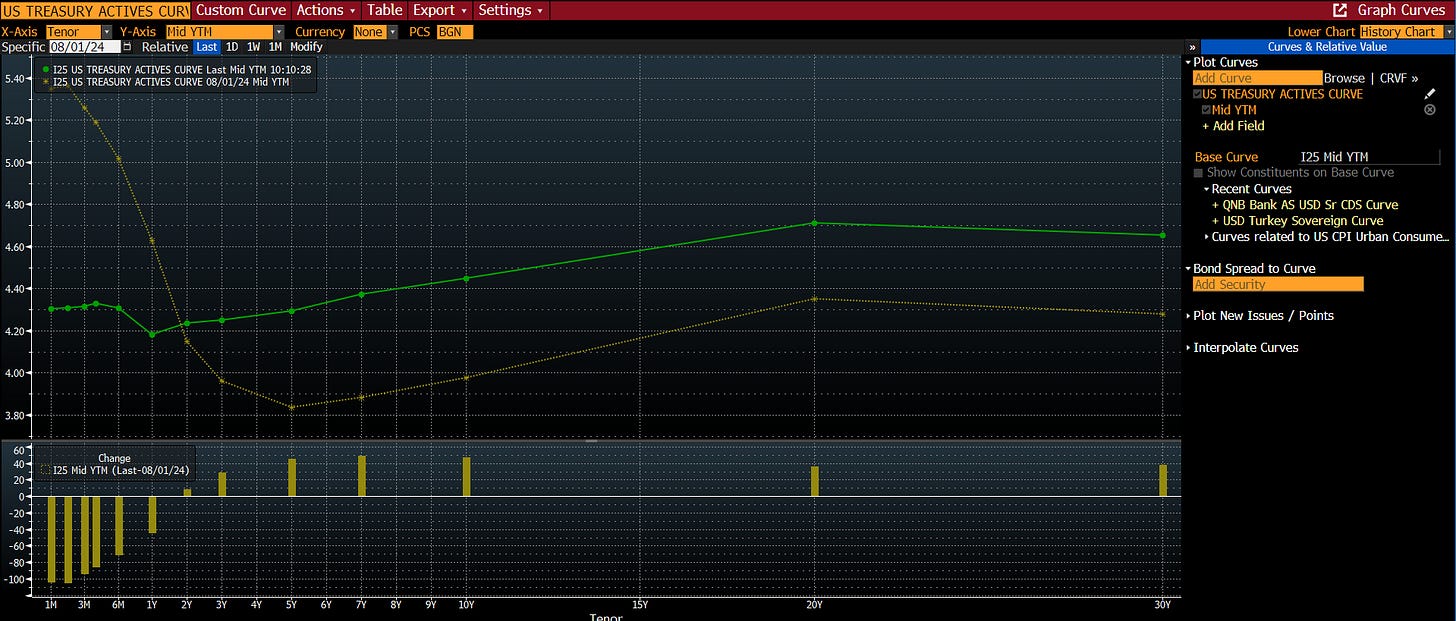
US Treasury Curve (August vs February)
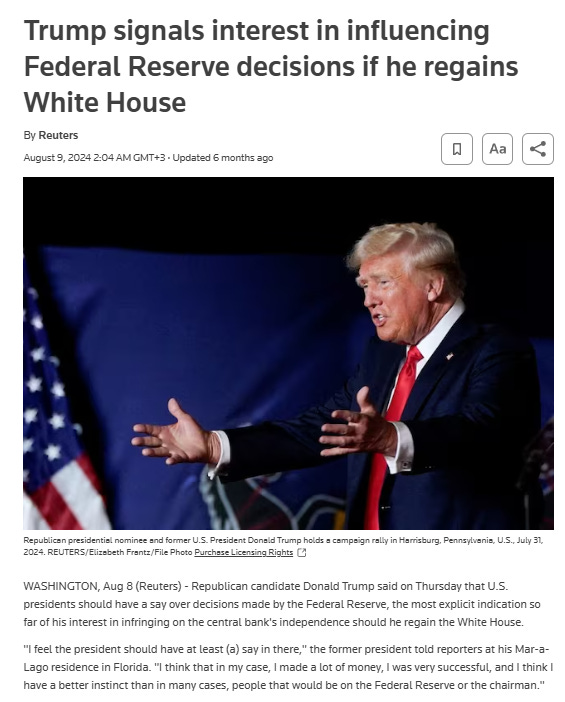
So, why does the treasury market hated Donald Trump so much and reacted in panic? First, the president has been known by his willingness to interfere to the treasury market. Before the inauguration, his speeches were basically shittalking about the Powell, saying that “He knows better about the economy” and bullying him to lower interest rates. This has of course has not worked very well for him, giving the signal that he wants to run a hot, a.k.a inflationary economy which is deadly for the long-end of the curve.
Another big debate going around for the last months is the effects of trade wars on the U.S. economy. The impact of tariffs on US 10-year Treasury yields is complex, shaped by a mix of inflationary pressures, growth concerns, and market sentiment. On one hand, tariffs can drive up the cost of imported goods, potentially fueling inflation. On the other hand, tariffs—especially in the context of trade wars—can slow global economic growth, particularly in export-dependent sectors. Additionally, tariffs can strengthen the US dollar, making Treasuries more attractive to foreign investors and further suppressing yields. However, if tariffs lead to larger budget deficits or increased Treasury issuance, yields could rise due to higher supply. Market sentiment also plays a key role: in the short term, the uncertanity in the market triggers a “risk-off” mode, pushing investors to decrease their beta exposure. In risk-off mode, investors become more cautious and seek to reduce exposure to risky assets like equities, commodities, or high-yield bonds. Instead, they flock to safer assets such as US Treasuries, gold, or defensive stocks (e.g., utilities or consumer staples).
However, I believe that the market misunderstood Trump’s impact and plans, and with the support of the media, the pricing reached very extreme points. This has created a unique situation that the being long duration (especially 10s and 30s) can be highly profitable. In this article, I will be talking about what might happen on a more macro scale, how the perception in the bond market might reverse in the future and the plans of the Trump and his team for 2025.
Trump’s Alternative Universe
Since starting his second term on January 20, 2025, President Donald Trump has rolled out bold plans to reshape the U.S. economy. From his inaugural address to his World Economic Forum speech and a flurry of executive orders, his policies could impact everything from energy costs to grocery prices.
On energy, Trump declared a national emergency to boost U.S. oil and gas production, aiming to lower gas and heating bills while creating jobs. He’s also targeting inflation, promising rapid cost cuts despite it already falling to 3%. On trade, he launched the “External Revenue Service” to collect tariffs on foreign goods, claiming it will generate “massive revenue” without taxing Americans. This ties into his aggressive stance with Canada, Mexico, and China.
Initially, Trump threatened 25% tariffs on all goods from these countries starting February 1, blaming them for fentanyl trafficking. After negotiations, he delayed tariffs until March 1, 2025, after Mexico pledged 10,000 National Guard troops to secure its border and Canada committed to new anti-fentanyl measures and border personnel. However, on February 19, Trump announced 25% tariffs on steel and aluminum imports from Canada, Mexico, and others, starting March 12. Canada vowed “swift retaliation,” as it supplies over 50% of U.S. aluminum and significant steel. Mexico called the move “unjustified,” fearing it could cripple their exports, 80% of which go to the U.S.
With China, Trump imposed a 10% tariff on all imports in early February, citing fentanyl concerns. China retaliated with 15% tariffs on U.S. coal and gas, plus export controls on rare metals. Trump hinted at more action, planning reciprocal tariffs on autos and chips by April.
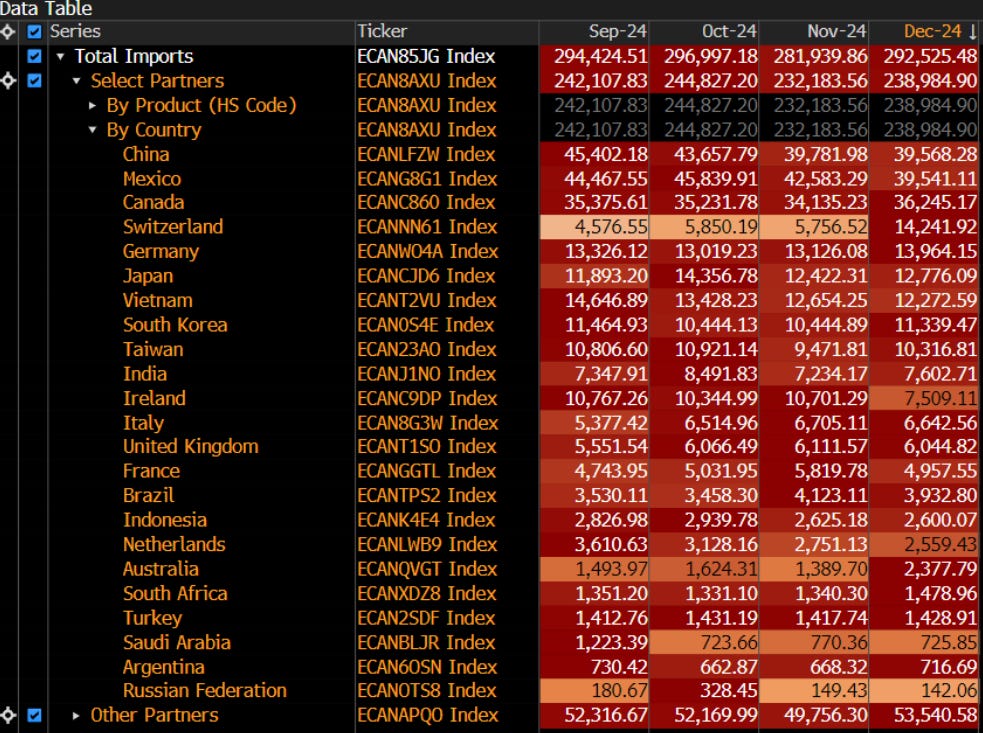
US Trading Partners
This slippery slope is very uncertain for US growth path, since many of the trade is between China, Mexico and Canada. Any trade war with these countries could hurt each other significantly, affecting the US economic growth outlook downwards. Economic studies estimate that broad tariffs could reduce US GDP growth by 0.5% to 1% annually, depending on retaliation and consumer responses. If Trump’s tariffs lead to a full-blown trade war, GDP growth—currently projected at 2.5% for 2025—could drop below 2%, as higher inflation and lower trade volumes offset domestic gains.
Tariffs: Inflation or No inflation
Tariffs, which are taxes on imported goods, can lead to inflation by increasing the cost of these goods for consumers and businesses. This can raise overall prices, contributing to inflation. However, the extent depends on factors like the importance of imported goods in the economy and how people and businesses react. During Trump’s presidency, his administration imposed significant tariffs, and cabinet members like Steven Mnuchin and Larry Kudlow argued that any price increases would be minimal or temporary. Studies, however, show mixed results, with some indicating notable inflationary effects, especially with large tariffs.
Members of Trump’s cabinet, including Treasury Secretary Steven Mnuchin, Economic Advisor Larry Kudlow, and Commerce Secretary Wilbur Ross, generally minimized the inflationary impact of tariffs. Mnuchin claimed China bore most costs, suggesting little effect on US consumers. Kudlow acknowledged possible temporary price hikes but said broader policies would counteract inflation. Ross called any price increases “trivial,” downplaying concerns. This view contrasts with economic studies showing potential significant inflation. It’s surprising that while tariffs directly raise prices, their long-term inflationary effect can be limited if central banks adjust policies or consumers switch to domestic goods, potentially offsetting initial price hikes. Here is the US CPI data MoM and its breakdown. As it can be seen, the trend in inflation is downwards but remains elevated in the latest months since elections:

However, I believe that the current outlook portays that the anti-growth effects of the tariffs will more than the inflation effects, offsetting and even overcoming this effects. The reason for that is the tariffs imposed to Canada, Mexico, China or Europe will be retaliated, meaning that it will affect the global US companies and therefore, their growth expectations. This will affect the US companies one-by-one in chain, leading to shrink their sizes and maybe layoff their workers, meaning a lower household income. Some of the companies, like Walmart already highlighted the weakness from abroad.
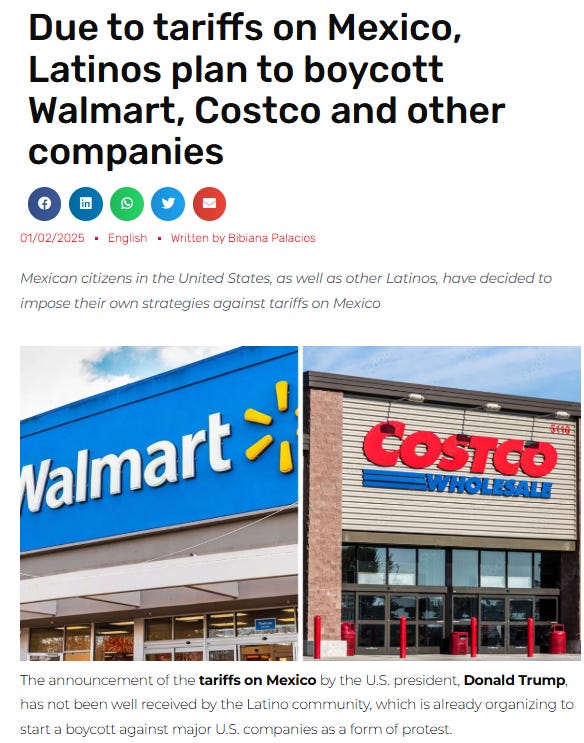
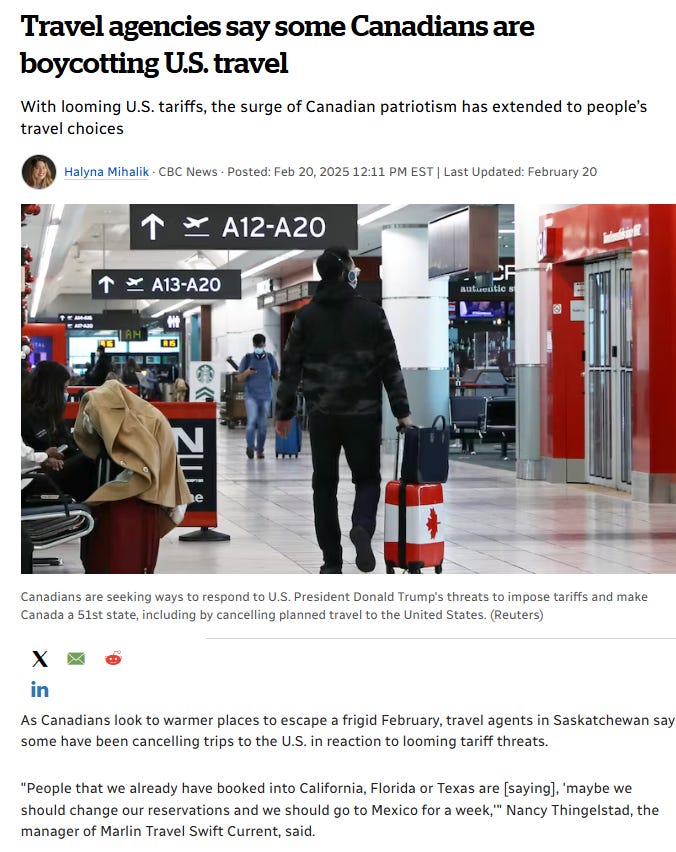
Here is the comment from the economists magazine: “So tariffs raise prices. Does that mean they cause painful inflation? Not necessarily. A one-off increase in prices might create only a short-term pop in inflation, not a sustained rise. Tariffs erode consumers’ overall spending power, and falling consumption of things produced at home creates offsetting disinflation over time. Yet there is at least a danger that a one-off shock would set off an upwards spiral of prices and wages. After several years of high inflation, such a risk is now more pronounced.”
Bessent and Powell
Scott Bessent, appointed as U.S. Treasury Secretary in 2025, brings significant financial expertise to Donald Trump’s cabinet. With a background as a hedge fund manager, including roles at Soros Fund Management and founding Key Square Group, Bessent has deep knowledge of global markets and investments. His importance is heightened by his role as a major donor, fundraiser, and economic advisor during Trump’s 2024 presidential campaign, aligning with Trump’s economic policies like tariffs and tax cuts. His ability to engage across party lines, despite past Democratic support, and his global perspective make him a strategic choice for implementing Trump’s economic agenda.
Bessent supports implementing tariffs as a tool for remedying unfair trade practices, raising revenue, and negotiation, particularly with China and Mexico on issues like fentanyl. In his confirmation hearing, he debated the impact, arguing against the view that tariffs are inflationary, citing historical tariff theory and currency appreciation (e.g., a 10% tariff could lead to 4% currency appreciation, offsetting costs). He views tariffs as a negotiating tool, less likely to implement broad steep tariffs that could stoke inflation.
A cornerstone of Bessent’s plan is reducing the federal deficit, with a specific target of 3% of GDP by 2028, part of his “3-3-3” plan discussed at the Manhattan Institute This involves addressing the current deficit at 7% of GDP, focusing on spending cuts rather than tax increases. He suggested returning to pre-pandemic spending levels, with a baseline of $5.5 trillion to $6 trillion compared to the current $6.9 trillion, emphasizing no revenue problem but a spending problem. This idea explains the huge authorization given to Elon Mush when you look at the practices of DOGE in the upcoming section.
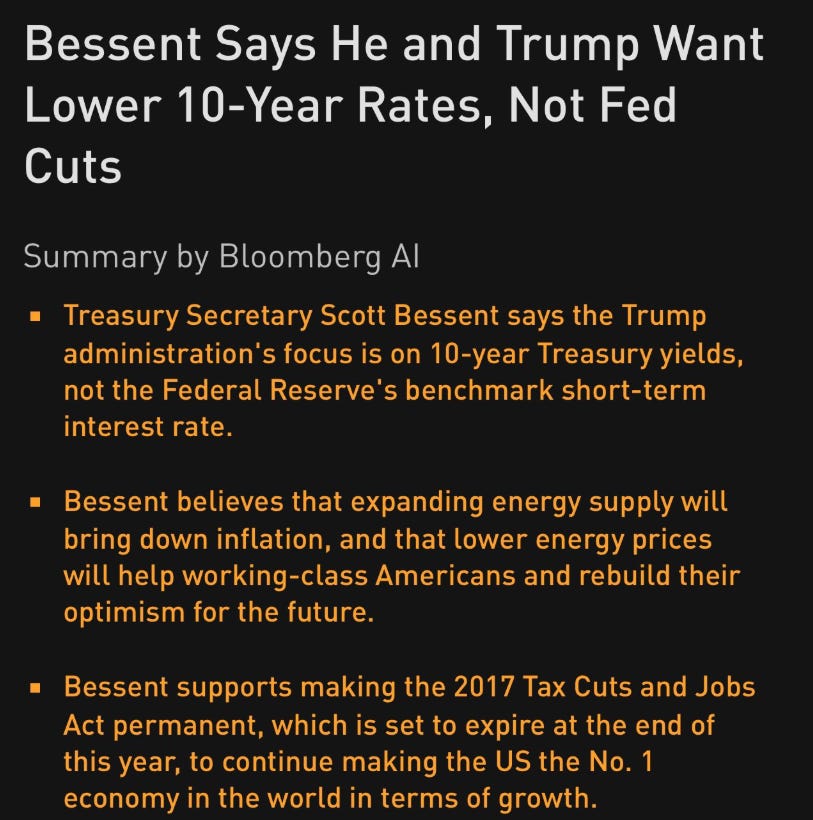
On the Powell’s side, the most recent FOMC meeting before occurred on January 26-27, 2025, has also made the market question its belief about rate cuts in the short term. Currently, the market is pricing almost no rate cuts for the year 2025. Here are the some statements made by the Federal Reserve Board:
-
“Recent indicators suggest that economic activity has continued to expand at a solid pace.”
-
“The unemployment rate has stabilized at a low level in recent months, and labor market conditions remain solid.”
-
“Inflation remains somewhat elevated.”
-
The Committee decided to maintain the target range for the federal funds rate at 4.25% to 4.5% percent, indicating no immediate rate cuts.
-
The Fed will “carefully assess incoming data, the evolving outlook, and the balance of risks” for future adjustments.
My thesis is that the upcoming datasets will be anti-growth while the FED is sustaining its hawkish stance and wait to see the trend, which will take some time to adjust and effect the long-end quite positively
Another speech between Powell and Bessent has been the current balance sheet of the FED. Currently, FED has approximately $4.25 trillion in US Treasuries and $2.22 trillion in Mortgage-Backed Securities (MBS). 1The rumors were that the Powell wants to shrink the Central Banks MBS holdings and replace some of them with bonds. However, this has been an issue for 2.5 years. You can see the news below. In 2022, the FED was holding $2.74 trillion worth of MBS. It has shrinked almost 20% since then, however, rumors imply that Bessent and Powell are in talks of replacing them with US Bonds. While the quantitative easing is far from discussing, buying long-dated bonds would be great signal and benefit the prices.
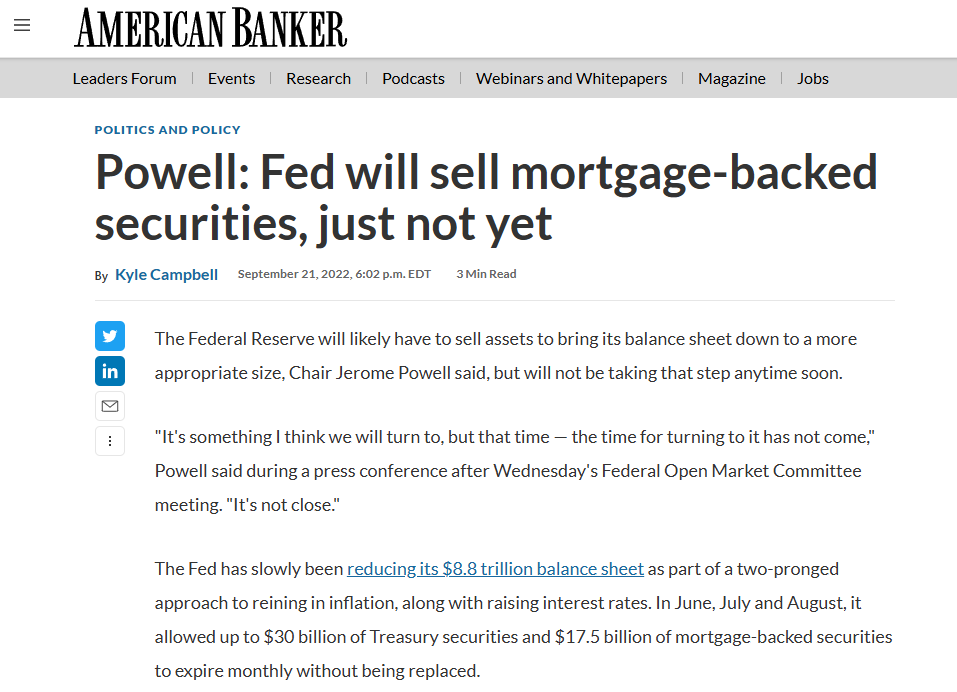
The Fed’s past LSAPs, often referred to as quantitative easing (QE), can provide a basis for estimating the impact of buying an additional $2.3 trillion in US bonds. A detailed event study from Gagnon in 2011 found that total LSAPs of about $1.7 trillion led to a cumulative decline of 91 basis points in the 10-year Treasury yield, based on market reactions to announcements. This suggests a decline of approximately 53.5 basis points per trillion dollars purchased.
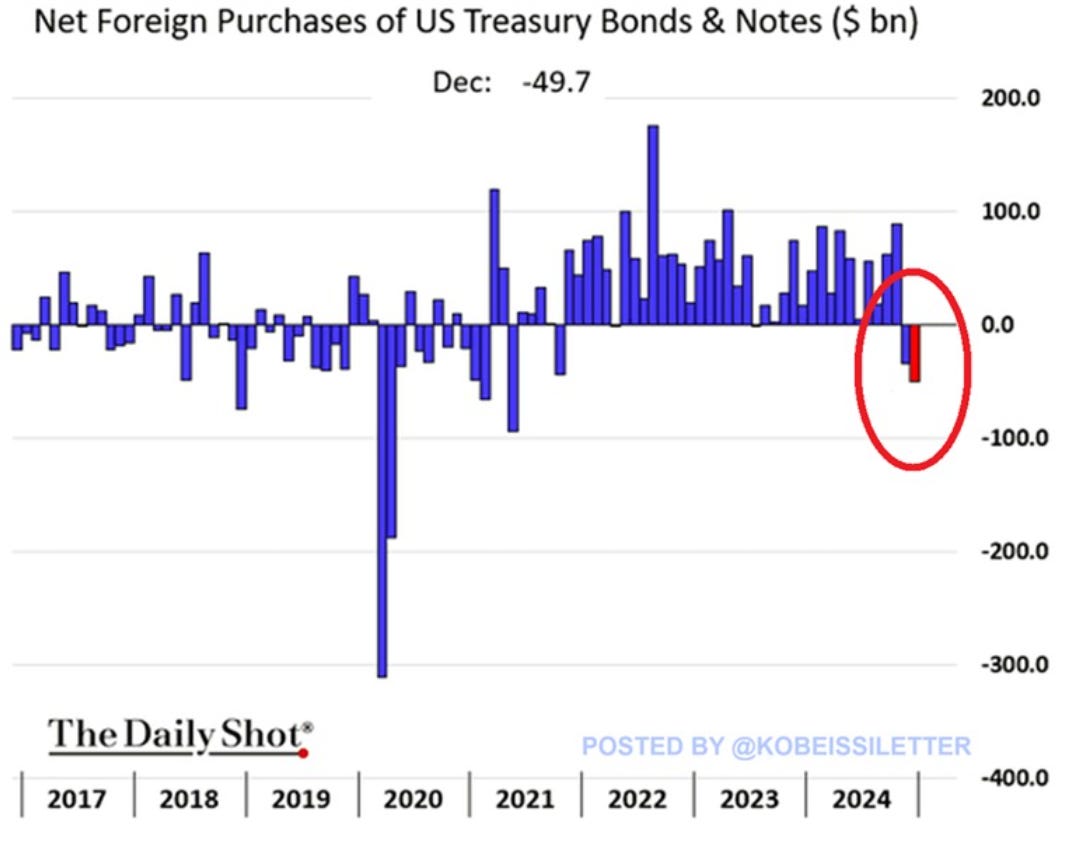
The foreign positioning and net purchases has also been at its lowest levels. Foreign holdings of US Treasuries dropped $49.7 billion in December, the biggest drop since March 2021. This was the second consecutive month of selling after $30.0 billion in November. The world’s largest foreign holders of US federal debt continued to reduce the exposure last year. China’s holdings fell $76.9 billion in 2024, to $759.0 billion, the lowest since 2009. Additionally, Japanese Treasury holdings decreased $57.3 billion, to $1.06 trillion, the lowest since 2018.
Department of Goverment Efficiency (DOGE)
One highly underestimated development has been the Department of Government Efficiency (DOGE), led by Elon Musk himself. The initiative was launched by Elon and Vivek Ramaswamy, though Vivek resigned just a week after the inauguration. This has sparked rumors that the DOGE will remain largely verbal, taking no concrete actions to improve the United States’ expenditure outlook. However, I believe the capacity and influence of the DOGE—particularly Elon Musk—have been significantly underestimated. Once the effects on employment and fiscal growth begin to materialize, they could rapidly shock the market in the coming quarters.
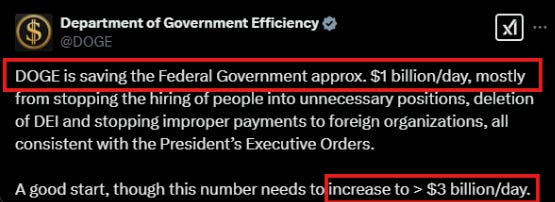
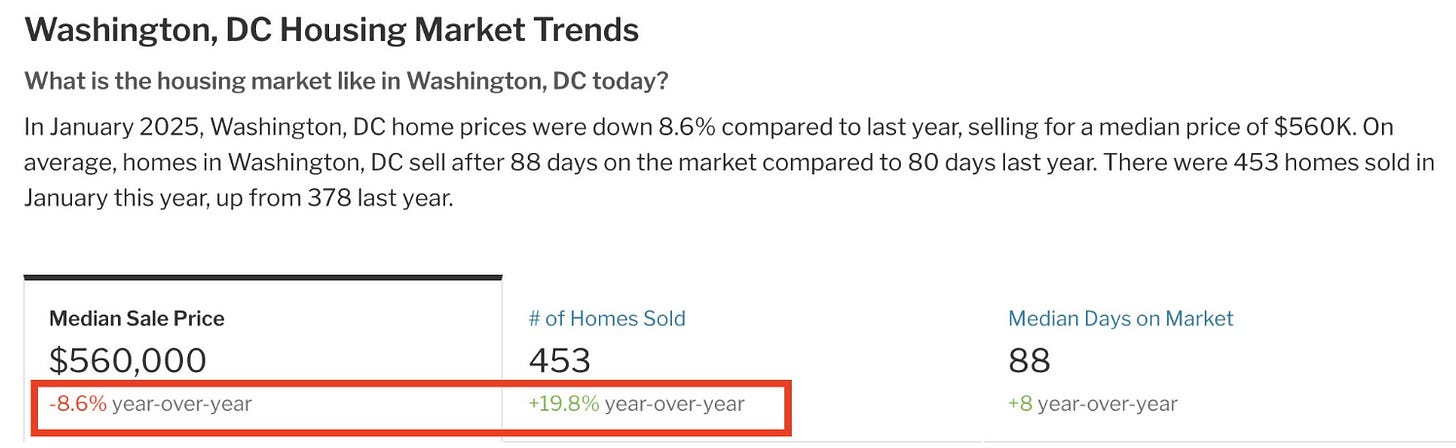
Elon has claimed that the DOGE has already saved $55billion (a figure that is difficult to verify) and has also suggested that they could cut annual spending by up to1 trillion. Even if these numbers remain unverified, the anticipation of upcoming audits for federal employees has already yielded interesting results. For instance, average home prices in Washington, D.C., have dropped by over $150,000.
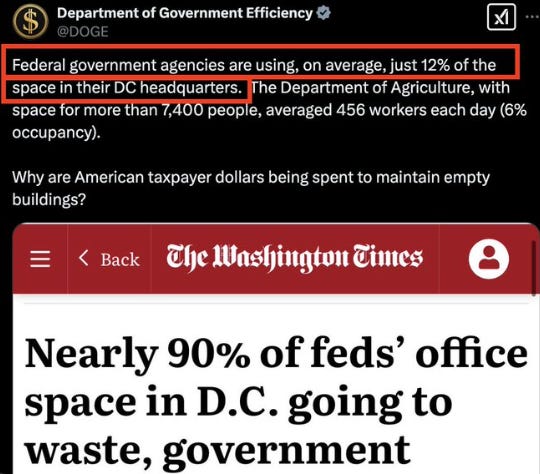
This decline is not specific to residential properties, the commercial property market in D.C. is also facing a dire situation. The DOGE has announced that two-thirds of U.S. government office buildings could be eliminated, noting that not a single major federal agency currently occupies even 50% of its office space.
Additionally, the impact of paid layoffs has yet to appear in jobless claims data. This is because affected employees cannot file for unemployment insurance, as they are still being paid for the next 6-8 months. As a result, it is difficult to estimate the full effects of these massive layoffs in the near future. If DOGE succeeds in slashing $1 trillion in annual spending, this could reduce the federal deficit, potentially lowering Treasury issuance. Less government borrowing might ease upward pressure on bond yields. On the other hand, aggressive austerity could also slow economic growth and weaker growth could fuel expectations of Federal Reserve rate cuts, further dropping the long-term yields.
Closing Remarks
The analysis honestly could go on forever and every day is a new day under Trump, so the narrative can be change within days. However, in the case of a potential market drawdown, I believe that the most solid play here is the US bonds. The stock markets are going crazy over the AI, creating a huge wealth for everyone and boosting the wealth and spending even more. Since Trump has been elected, many argued that S&P or NASDAQ has become extremely overvalued, but nothing has happened so far. However, I believe that something will happen in 2025 that will affect risky assets quite sharply, even though I don’t know what it will be, I know that I don’t want to take a position against it. As Nassim Taleb says, “It is far easier to figure out if something is fragile than to predict the occurrence of an event that may harm it”.
Thanks for your time.