This post was originally written in Turkish and translated into English with AI.
Welcome to the second-quarter investor letter. As of today, the CKL fund is one year old. My thanks to everyone who has followed along and invested. I will try to make this letter a bit longer and more detailed than usual. First, I will cover the fund’s performance and a few key parameters, and describe the management style I adopted during the months spent between war and rally. To close the letter, I will visit the mental models of two important fund managers.
Fund Performance
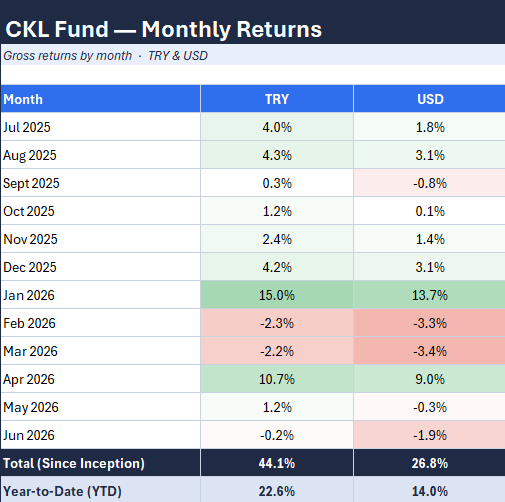
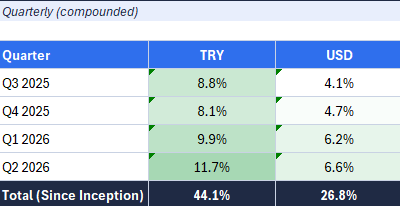
Annualized volatility came in at 17.4%. The sharp divergence in sub-sector performance abroad has lately been the decisive driver of returns for many funds. While we continue to hold the players we like, I remain of the view that a portfolio purely dependent on the AI theme makes no sense in risk-return terms.
April was one of the most exhausting months from a fund management perspective. With the news flow so broken and manipulative, we spent several weeks trying to avoid weekend risk. Positive headlines released while US markets were open were followed, weekend after weekend, by rising tension and escalating rhetoric. To avoid taking these risks — and to avoid the “back pain” I will get to in the mental models section — we reduced our positions on Fridays and brought the weights back to normal on Mondays. This did not contribute much to the fund, but I still consider it a sensible precaution against a bad development that could have materialized. I can say that entering the weekends with light positions allowed us to read the news flow better and stay calm.
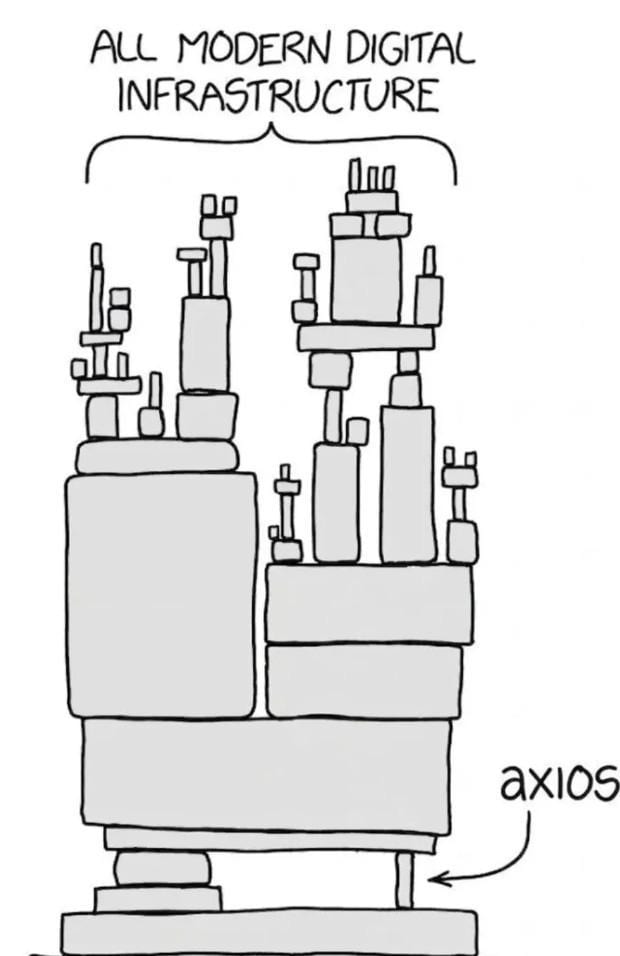
In the second week of May, we gradually said goodbye to our Intel positions, which we had carried at a cost of roughly $35. Intel was the thesis in which we held our highest weight, and it played out very fast and very sharply. At this point I should note that the company’s turnaround story is now priced in; from here, flawless products and capacity expansion are what is required. The Malaysian CEO is a man who likes to keep expectations low and outperform them, but on the Intel side expectations are now very high. Even though I personally believe the road ahead is wide open, I did not want to keep the position while we have yet to see any improvement in the EMIB advanced packaging segment.
Expectations From Here
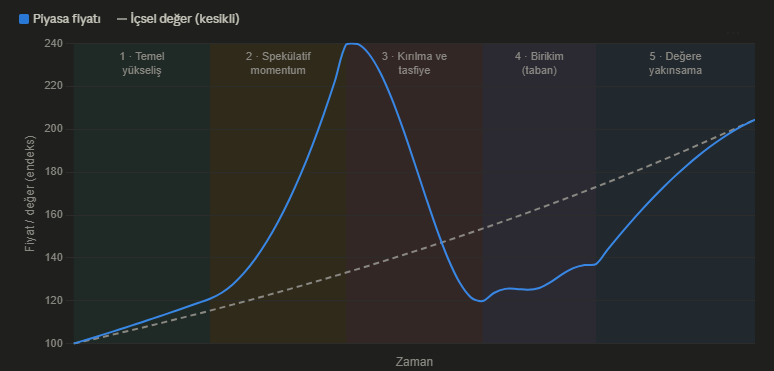
We are in a period where companies rise for fundamental reasons, then gain powerful momentum on speculative impulses and drift away from their intrinsic value, and then that momentum breaks, inflicting serious losses on leveraged investors. As things stand, I believe staying positive is warranted and the story on the AI side has not yet broken. I consider the current pullbacks healthy, and we see them as an opportunity to accumulate fundamentally sound companies both in Turkey and abroad.
Since I will be writing in the future about the sectors and stocks we hold in the fund as well as those we study for research purposes, I will not go through the positions one by one in this letter. We enter earnings season at the end of July, and there the companies’ forward guidance will be the deciding factor.
On Mental Models
In this letter I want to turn to George Soros and Stanley Druckenmiller, because they are an important pair for showing that investing is not merely an analytical discipline but also a philosophical and psychological experience. Holding two relatively different perspectives, these men brought the investment world a new way of looking at things beyond old school value investing.
Reading Soros as an ordinary trader is a mistake. He was a student of Karl Popper at the London School of Economics, and he saw his investment career as the applied test of a philosophical theory. He says so explicitly in the preface to The Alchemy of Finance. At the center of Soros’s theory is the concept of reflexivity. Classical finance assumes that prices converge toward equilibrium around fundamentals. Soros rejects this. In his view, the perceptions of market participants change the fundamentals themselves, and this loop feeds on itself, moving away from equilibrium.
Today’s hyperscalers make a fine example. The massive AI spending initiated by the Mag7 companies created a self-reinforcing positive feedback loop that drove share prices into an upward cycle. Rising share prices and valuations lowered these companies’ cost of capital while adding extra fuel to their capacity to grow. Today we can see these companies issuing enormous amounts of debt at cheaper rates than most developed countries. In short, a structural shift in perception extended the cycle. The longer this cycle runs, the more violent the moment of truth will be. The priority here does not actually lie in preparing for the crash scenario — it lies in adding to positions the moment the reflexivity loop strengthens, and thereby contributing to the cycle’s extension.
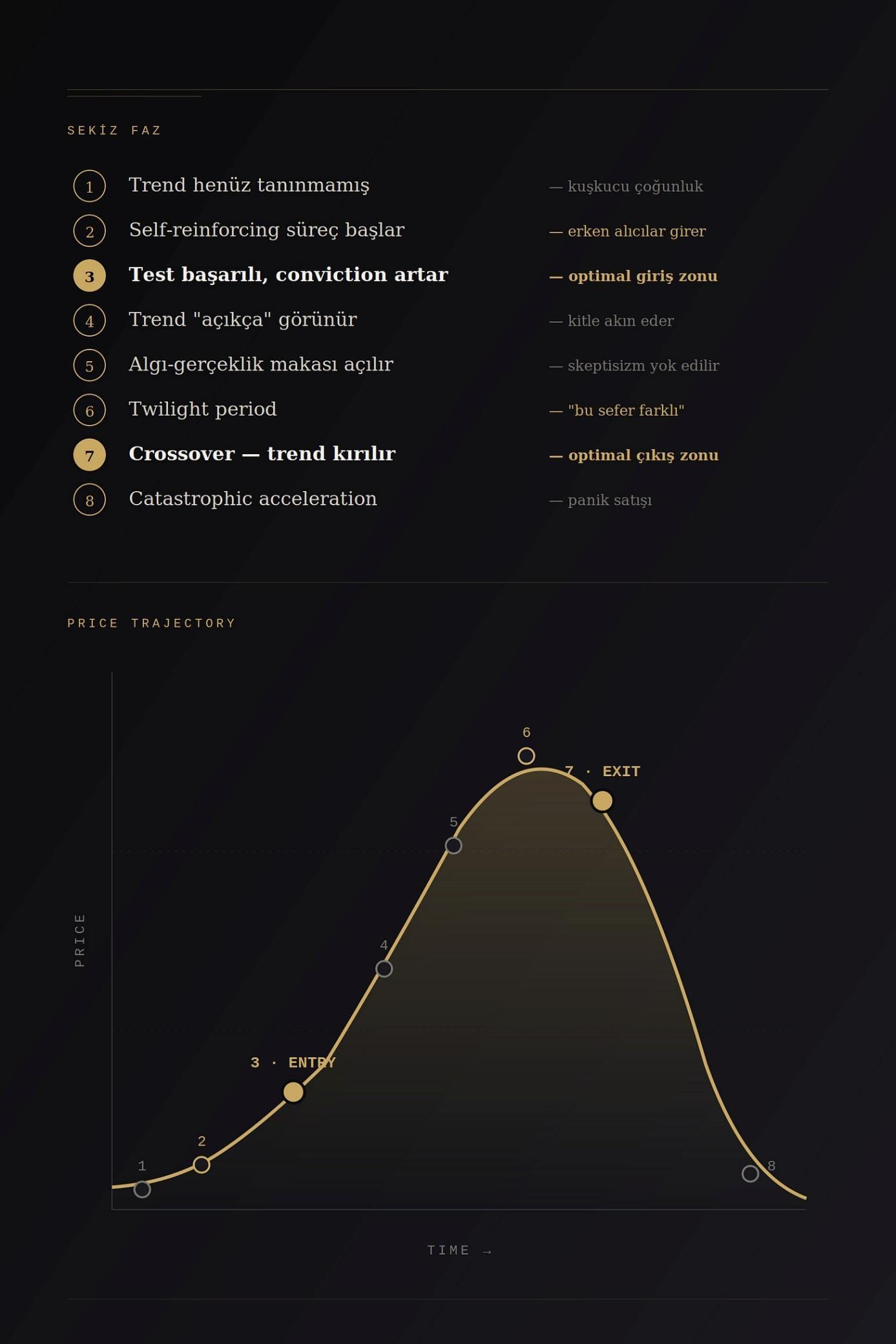
Soros describes receiving a physical signal — a back pain that tells him something is going wrong in his positions. This may sound mystical, but its essence is this: the unconscious mind surfaces information the analytical mind has not yet processed, in the form of a bodily warning. The same theme appears in Druckenmiller as the “hot streak - cold streak.” Pattern recognition developed over years in the markets bypasses conscious thought and manifests as a “warning.” In his own words, when the back pain started he would review his positions, and more often than not he would find an inconsistency somewhere. He would cut the position or hedge it without waiting for analytical proof. In this scenario, the body gets ahead of the evidence.
In parallel with this view, for Soros being right matters far more than being first, because at the point where you are right, the delay in timing can be made up by increasing the size of the position.
Druckenmiller, having worked alongside Soros at the Quantum Fund for years, is more interested in the model’s practicality than in its theory. He waits for what we call the inflection point — the moment the investment thesis will be triggered — and sees no logic in positioning early. (Being early is the same as being wrong.) He calls this “the gun and the trigger”: the thesis, and the catalyst that will make the thesis play out.
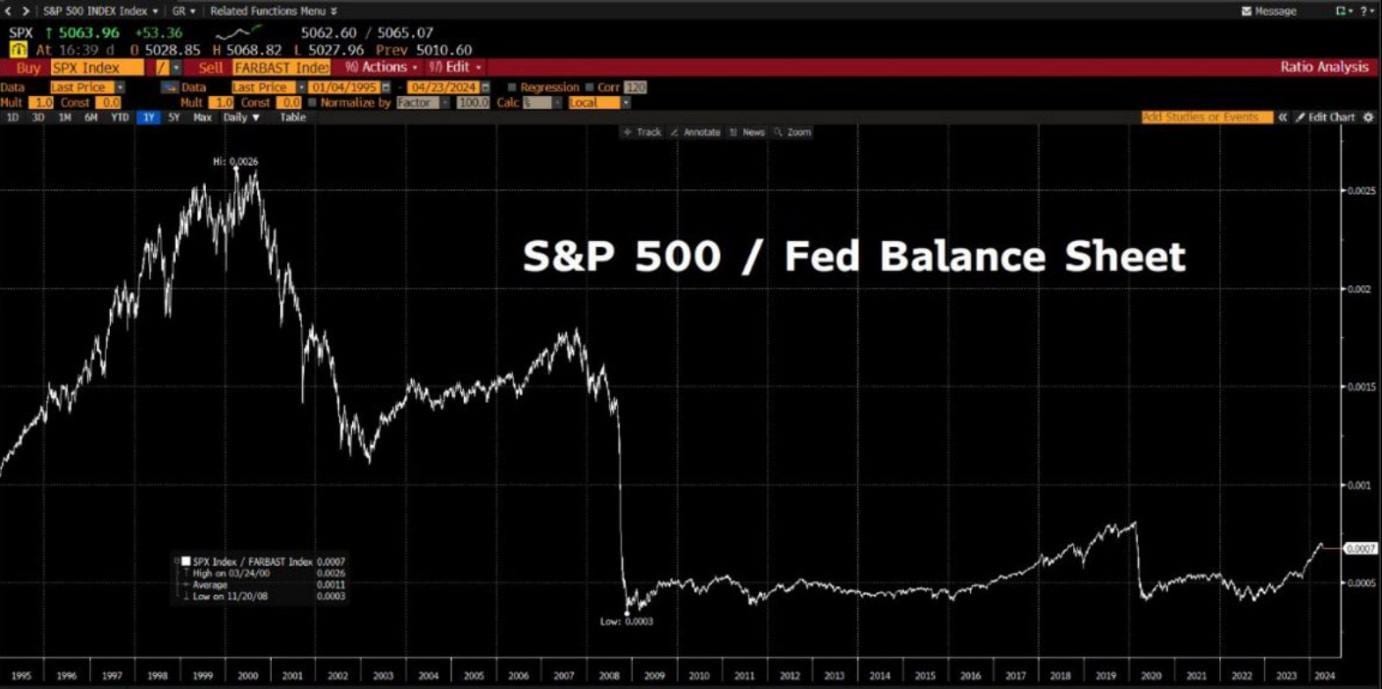
His most frequently repeated line serves as a good example: “Earnings don’t move the overall market; it’s the Federal Reserve. Focus on the central banks and focus on the movement of liquidity. It’s liquidity that moves markets.” This approach, which looks obsessed with liquidity, is in fact obsessed with its second derivative — the rate of change — because what matters for the next 12-24 months is the new liquidity coming into the market.
The other point is the use of valuation not as an investment thesis, but as a profit-taking point. For Druckenmiller, valuation gives you an impression of how large the payoff could be if the thesis plays out after the position is taken. An expensive market can stay expensive for years; a cheap market can get cheaper. What times the entry into a position is not valuation, but the alignment of liquidity and catalyst. Once that alignment is in place and conviction begins to build, the position is scaled up convexly. “The Pig Zone” — an expression we might render in Turkish as “taking a position so big you’d be embarrassed by it” — aims, much like Soros, at taking positions of great size precisely where conviction is rising.
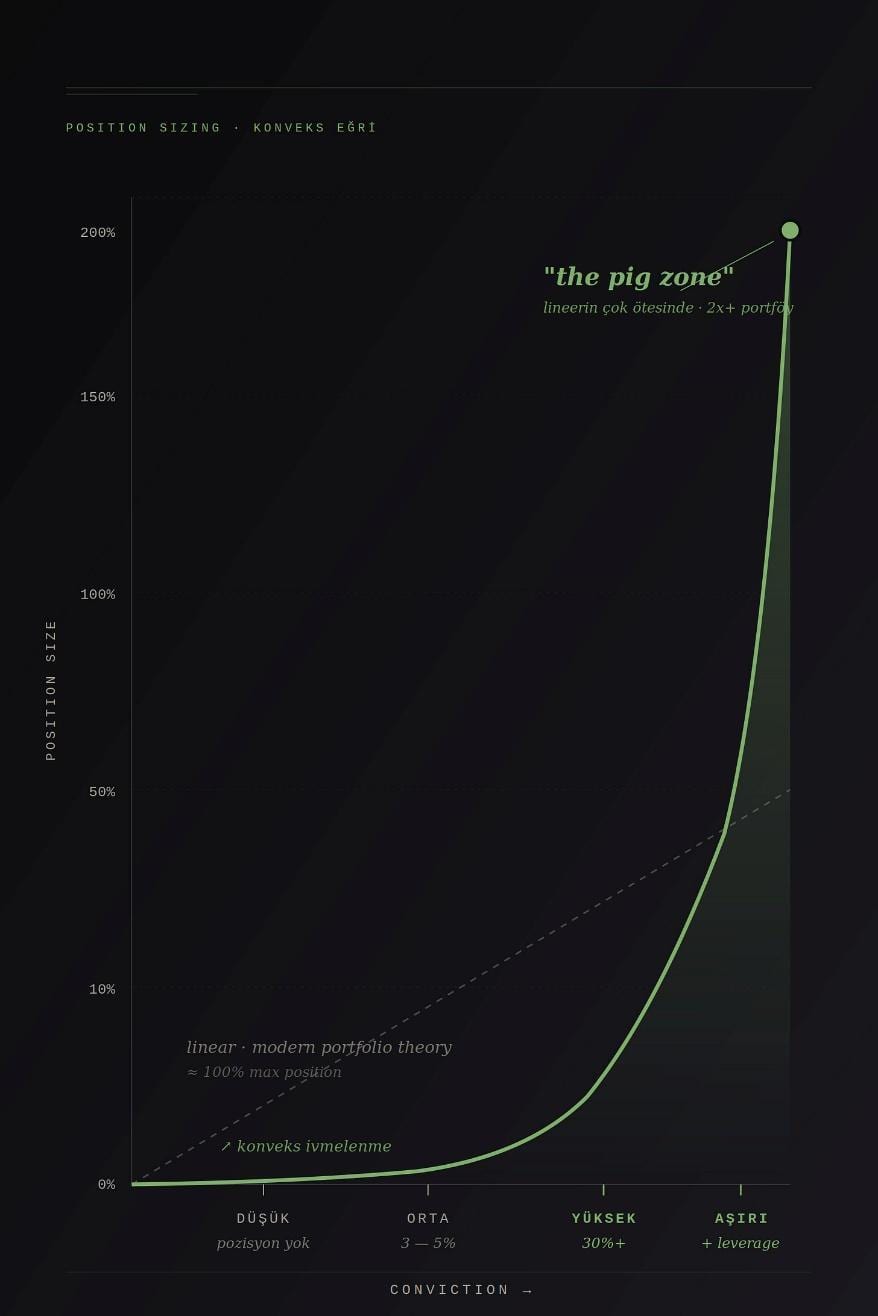
“Bulls make money, bears make money, and pigs get slaughtered. I’m here to tell you I was a pig. It takes courage to be a pig. The only way to make long-term superior returns is by being one.”
In managing the CKL fund, what I try to do — against our instincts — is this: to distinguish clearly between winning and losing theses, and to concentrate on the winners rather than add to the losers. Markets do produce anomalies from time to time, but at the point where price action fails to confirm a thesis, I treat that not as simple noise but as a signal of information asymmetry. In an era when insider activity has been legitimized through venues like Polymarket and Kalshi, every moment when asset price movements deviate from randomness can often be the moment when information not yet priced in is surfacing. That is why I believe it is more correct to treat price action not as a confirmer of the thesis, but as a feedback mechanism that recalibrates conviction.
Disclaimer
This post is prepared for informational purposes only; it does not constitute investment advice, a recommendation to buy or sell, or an offer relating to any security. The views and analyses expressed here reflect the author’s personal assessments and do not represent the official view of any institution he is affiliated with. The author may hold positions in the securities mentioned. Past performance is no guarantee of future results. Every investment carries risk; investors should do their own research and consult a licensed investment advisor where necessary. The information here is based on publicly available sources, and no guarantee is given as to its accuracy or completeness.